

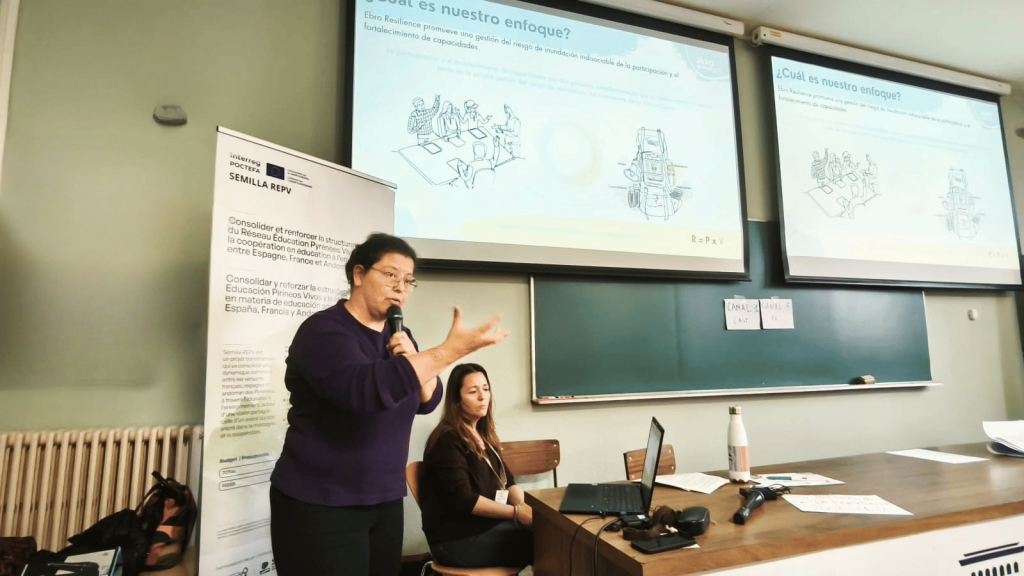
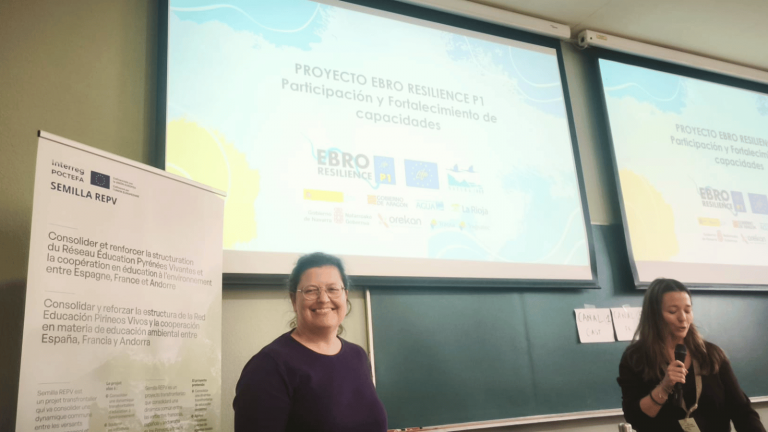

On November 17, LIFE Ebro Resilience participated in the meeting of the Pirineos Vivos Education Network (REPV), which this year was held in Jaca under the theme “Adapting and Supporting Territories” and brought together more than 200 professionals from France, Navarre, Andorra, Catalonia, and the Basque Country, as well as a team of environmental technicians and educators from the Aragón Nature Network .
The presentation took place as part of the “Zoom Territorio. Getting to Know Aragón” session, a panel dedicated to showcasing initiatives developed in the host region and organized as part of the Network’s annual meetings. During the session, the Government of Aragón, one of the partners in the LIFE Ebro Resilience P1 project, presented various initiatives related to environmental education, territorial cooperation, and the adaptation of regions to current environmental challenges.
On behalf of the project, Alba Ballester (TRAGSATEC), who is in charge of engagement and capacity-building initiatives, presented the work being carried out in collaboration with government agencies, organizations, community groups, and the public to enhance understanding of river dynamics and promote better adaptation to flood risk.
LIFE Ebro Resilience P1 takes an integrated approach to its actions, combining participation, social capacity building, communication, and adaptation projects across a broad territory and over an extended period of time. It is thus an interesting proposal for the environmental education sector as it reflects on how to combine education, outreach, and participation.
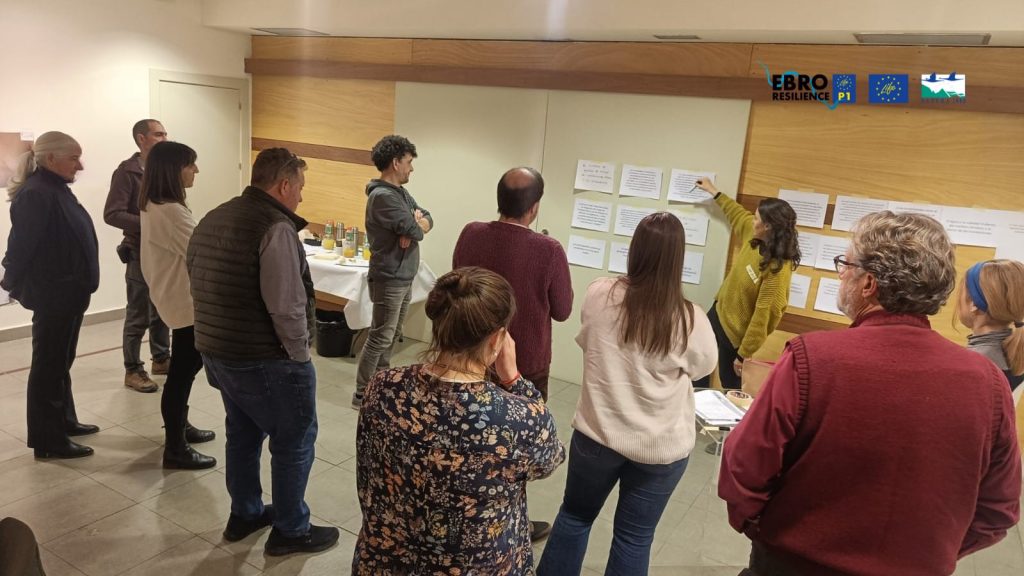
The shared experience highlighted the participatory processes promoted by the project, emphasizing the co-creation groups in the two intervention areas and the Permanent Conflict Transformation Group. It also highlighted the awareness-raising, education, and training initiatives aimed at the various stakeholders involved in land management.
Experiences
Co-creation groups are small groups where project partners and local stakeholders come together to discuss and jointly develop actions. These groups have been organized since the start of the project along the Alfaro (La Rioja) – Castejón (Navarre) and Osera de Ebro – Fuentes de Ebro (Zaragoza) sections.
For its part, the Conflict Transformation Group was established as a permanent forum to address—through active listening and shared analysis—the main points of tension surrounding flood risk management in the middle section of the Ebro River.
Strengthening social capacities is a key element in improving social resilience to flooding and the self-protection of riverside communities, which is a way to reduce risk. Since the project began, activities have been carried out through 16 campaigns targeting different segments of the population, including informational workshops, educational materials, boat trips down the river, interpretive trails, and deliberative forums…
Social participation and capacity building are among the strategic priorities of LIFE Ebro Resilience. Through workshops, training sessions, informational materials, and opportunities for dialogue with local stakeholders, the project promotes the involvement of citizens and local organizations in developing sustainable solutions for flood risk management.
POCTEFA
Semilla REPV project, an initiative aimed at strengthening and consolidating cross-border cooperation in environmental education and reinforcing the internal organization of the Pyrenees Living Education Network . By 2026, this network will have 97 member organizations from Catalonia, Aragon, Navarre, Andorra, New Aquitaine, and Occitanie.
LIFE Ebro Resilience’s participation in this forum provided an opportunity to exchange experiences with professionals in environmental education and territorial adaptation from both sides of the Pyrenees, as well as to showcase the project’s work to promote territories that are better prepared and more resilient to flooding.
LIFE Ebro Resilience Project P1
The LIFE Ebro Resilience P1 Project, which receives financial support from the European Commission’s LIFE Program, is an innovative initiative to address the issue of flooding in the middle reaches of the Ebro River, with a clear objective: to ensure that the population and economic activities coexist with an Ebro River in a good state of conservation, while reducing the damage associated with floods that are part of the river’s natural dynamics.
The project is led by the Ministry for Ecological Transition and the Demographic Challenge (MITECO), through the Ebro River Basin Authority (CHE), in collaboration with the public companies TRAGSA and TRAGSATEC, the Government of La Rioja, the Government of Navarre—through Orekan-Gestión Ambiental de Navarra—the Government of Aragon, and the Aragonese Water Institute.