


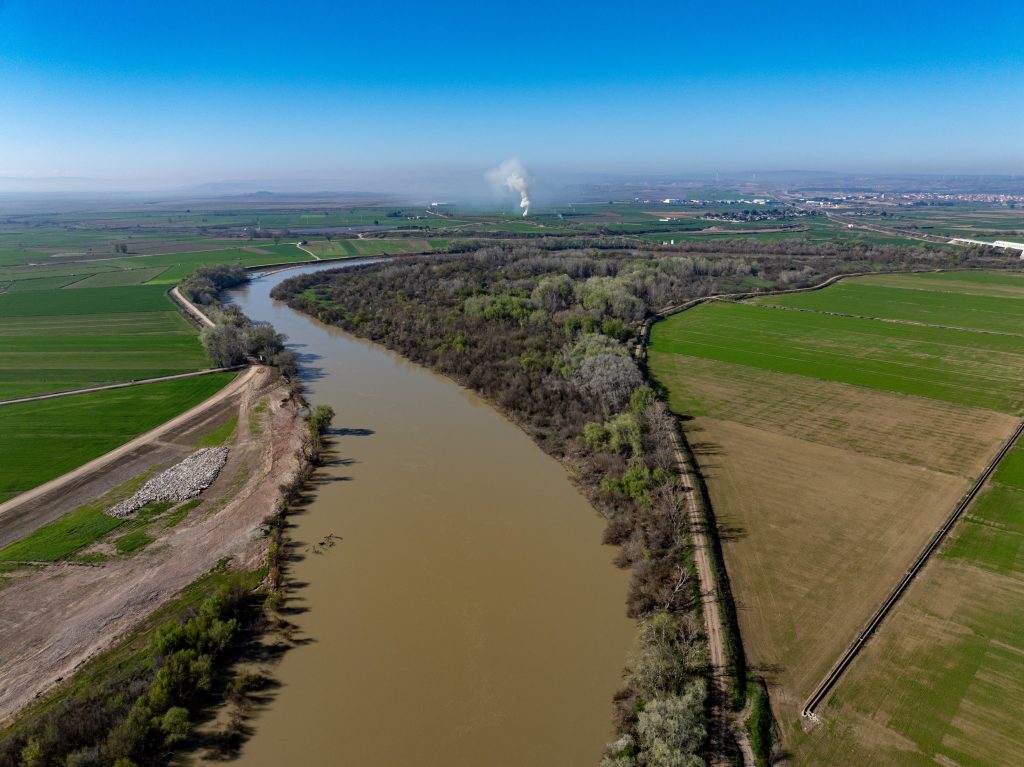
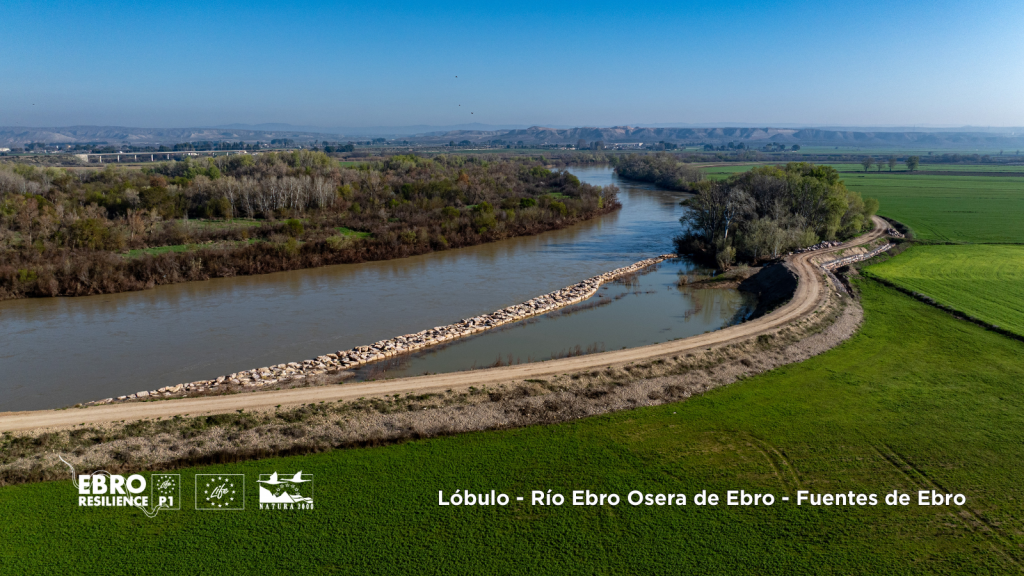
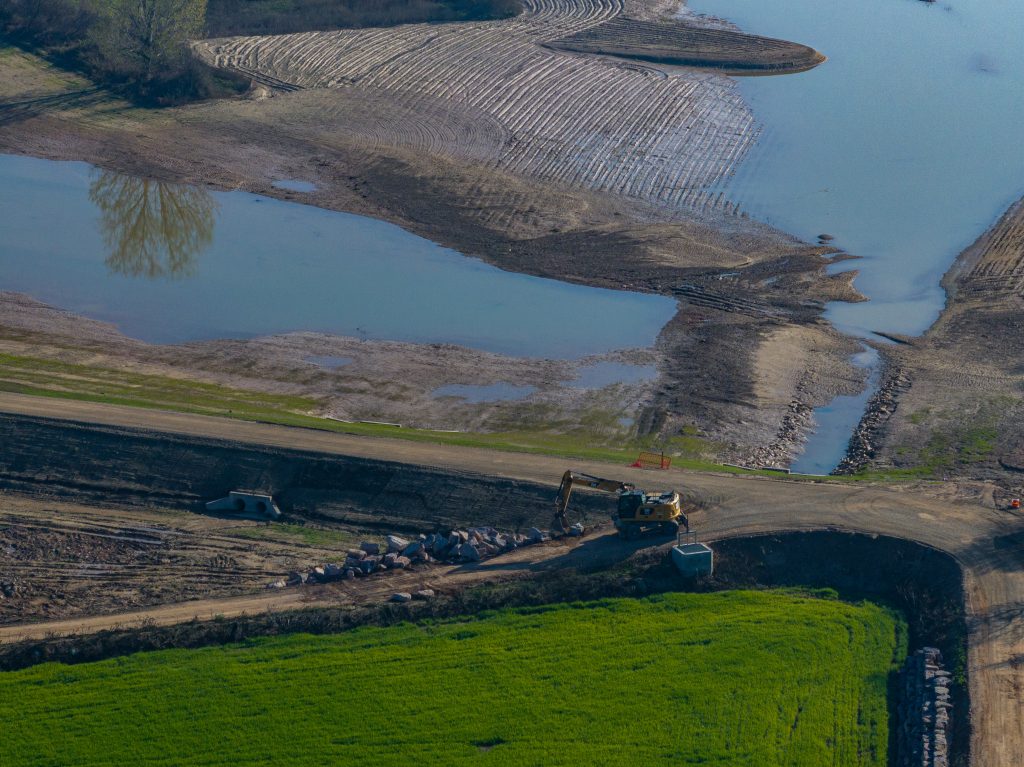
The LIFE Ebro Resilience P1 project continues to take decisive steps in the Osera de Ebro – Fuentes de Ebro (Zaragoza) section, where key actions are being developed to reduce the risk of flooding, improve the resilience of the territory and favor the natural dynamics of the river. The new images obtained in the Meandro de Aguilar (Zone 2) show clearly the magnitude and scope of these interventions.
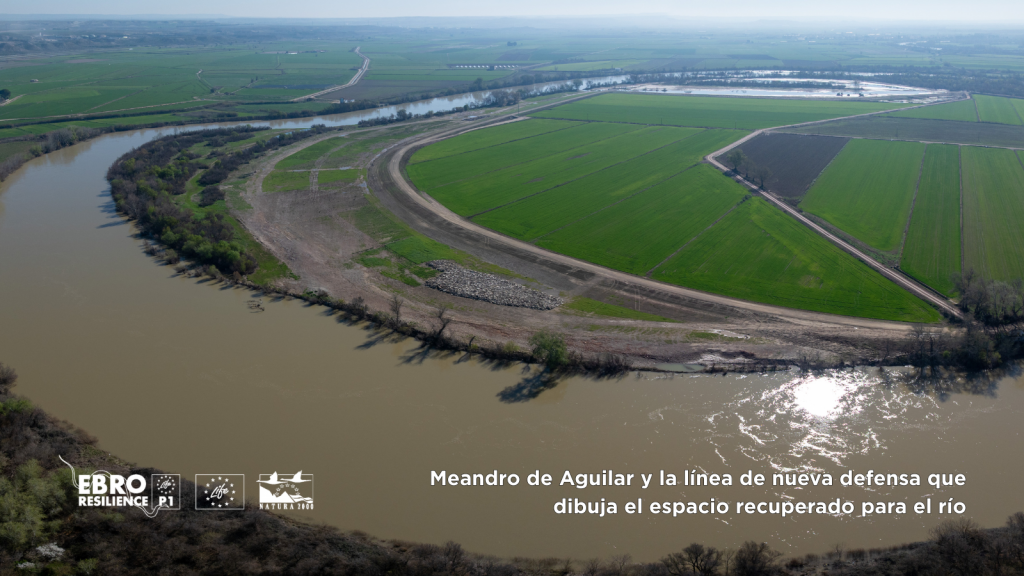
A meander that recovers river space
The first of the images shows the entire Meandro de Aguilar, where the line of the new recessed defense, built further away from the riverbed, can be seen. This action, which is part of Phase 1 of the project, has made it possible:
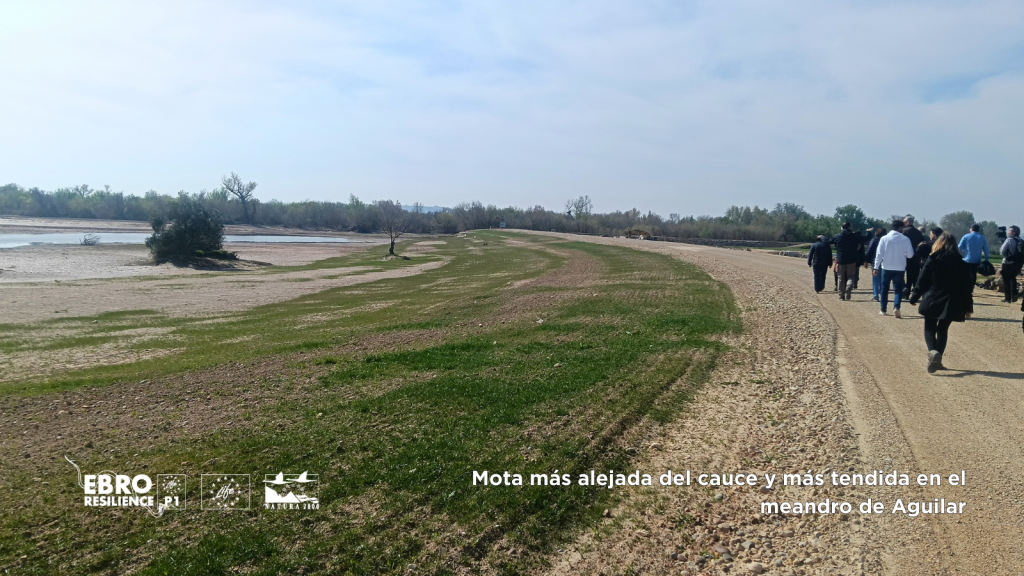
A tighter, more integrated and resilient defense
Another of the photographs shows the new defense already built, much more laid out and with gentle slopes. This design:
These defenses have been built by reusing the materials of the old dike, following sustainability criteria.
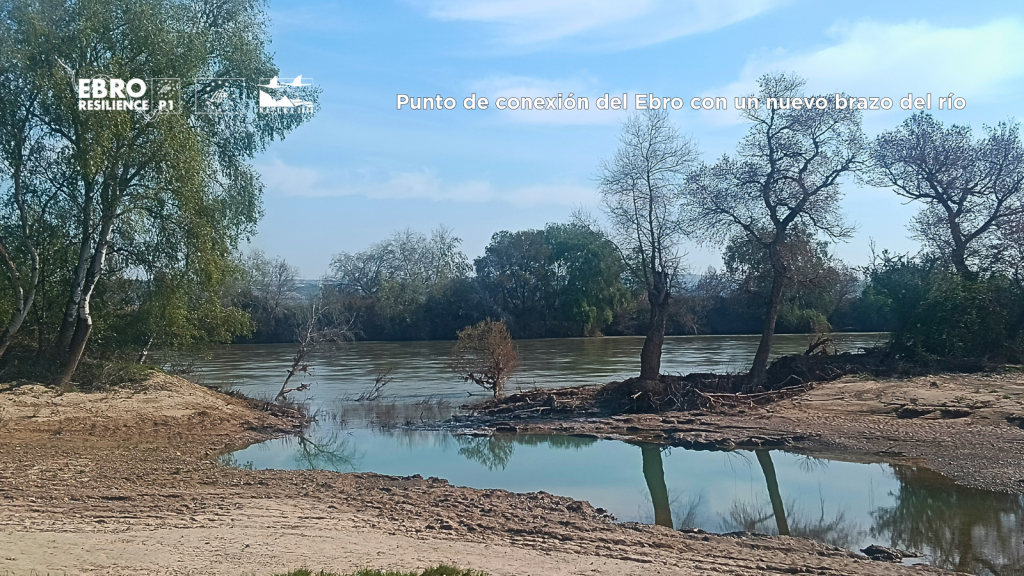
A new water inlet: reconnection with the natural area of the river
Another of the images shows the water inflow from the Ebro into one of the inner arms of the meander, a connection recovered thanks to the recessing of defenses and the creation of the new wetland. This opening:
A lobe to halt erosion: natural technology applied to the Ebro
The last image corresponds to a lobe, a nature-based solution that has been built in an erosion area of the Osera-Fuentes section. The lobes are:
General context of the actions in the Osera-Fuentes stretch
The interventions of the LIFE Ebro Resilience P1 Project in this section have allowed:
These actions have been developed with an extensive public participation process and the consensus of the municipalities and the Irrigation Community.
Current progress: definition of LFAZ closures
In parallel to these works, the project is progressing in the definition of the closures of the Lateral Flow Buffer Zones (LFZ), one of the most innovative interventions of LIFE Ebro Resilience P1.
The AFZs are temporary flooding areas that are pre-flooded in a controlled manner moments before extraordinary floods, acting as water cushions that:
We are currently working on:
A comprehensive project to coexist with floods
All these actions -retraction of defenses, creation of wetlands, construction of lobes and development of the AFZs- respond to the same objective: to reduce the risk of flooding through nature-based solutions, giving more space to the river and improving its behavior during floods.
The Osera-Fuentes section is thus consolidated as a laboratory of river innovation, a benchmark for other Spanish and European river basins.
LIFE Ebro Resilience P1 Project
The LIFE Ebro Resilience P1 Project, which has the financial support of the LIFE Program of the European Commission, is an innovative proposal to address the phenomenon of flooding in the middle stretch of the Ebro, with a clear objective for the future: that the population and economic activities coexist with an Ebro in a good state of conservation without the inevitable floods causing significant damage.
Its partners are the Ministry for Ecological Transition and the Demographic Challenge (MITECO), through the Ebro Hydrographic Confederation (CHE) and the public companies TRAGSA and TRAGSATEC; the governments of La Rioja, Navarra -through Orekan-Gestión Ambiental de Navarra- and Aragón, as well as the Aragonese Water Institute.