


This project will allow fish to pass through and improve the river’s longitudinal connectivity
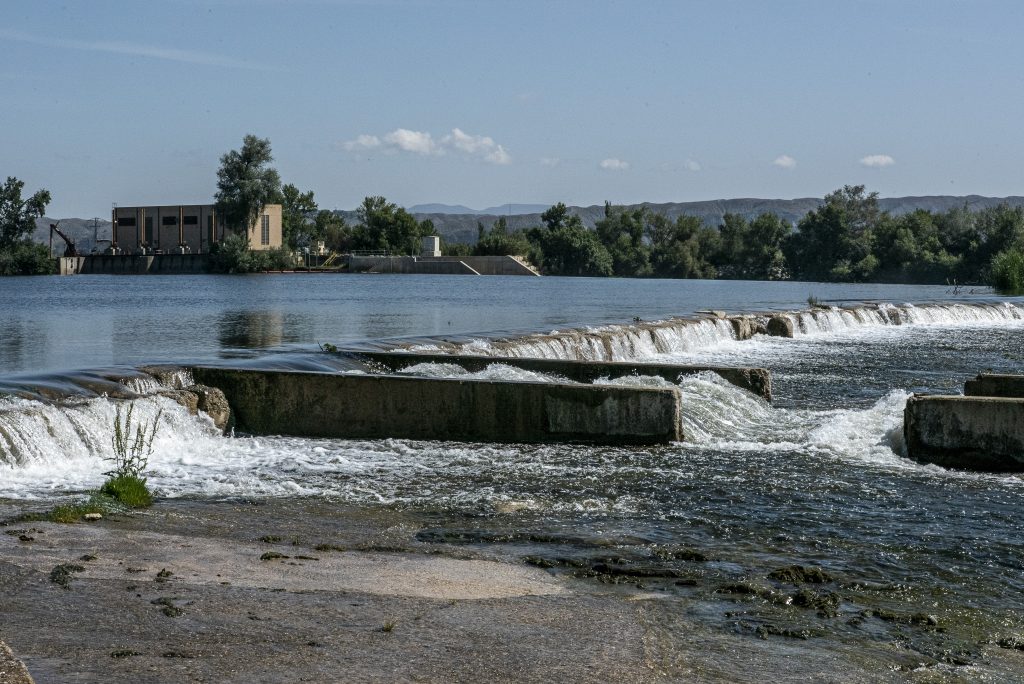
As part of the Ebro Ebro Resilience to reduce flood risk in the middle section of the Ebro, the Ebro River Basin Authority (Ministry for Ecological Transition and Demographic Challenge – MITECO), a partner in this Strategy, is carrying out construction work on a ramp that will allow fish to pass over the Pina weir. This weir is located on the Ebro River, between the municipalities of Nuez de Ebro and El Burgo de Ebro, in Zaragoza.
The main objective of the project is to improve the river’s longitudinal connectivity by allowing fish to pass through this weir, which will lead to an overall improvement in the ecological status of this section, in line with the philosophy of the Strategy underlying all the actions proposed for the middle section of the Ebro River.
The project, costing 950,000 euros and funded by the MITECO budget, began in the summer of 2023 and takes advantage of periods of low water levels and reduced flow to make progress. Throughout the project, construction has been carried out in a way that allows for the continued use of the infrastructure—a weir built in 1910 that supplies water to the irrigation canals of Pina, Fuentes de Ebro, and Quinto.
The project complies with the criteria of the European Water Framework Directive and the Public Water Resources Regulation, which stipulate that respect for the longitudinal and lateral continuity of watercourses must be promoted.
Performance
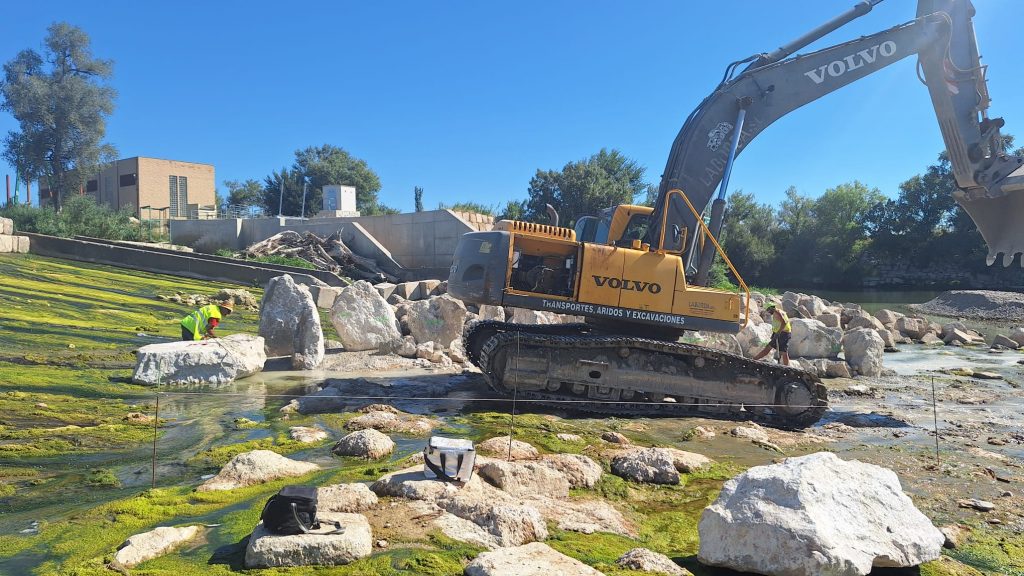
A stone ramp with a concrete breakwater is being built on the weir’s face; it will connect the water at the weir’s crest and at its base, allowing fish to pass through.
The interior of the ramp will be equipped with a zigzag row of boulders to ensure its proper functioning under the varying flow rates in this middle section of the Ebro River. At low flows, the water will flow between the rows of boulders, following a zigzag path with a significantly lower gradient than that experienced during high-flow conditions. In such cases, the water will occupy the entire width of the ramp.
In terms of dimensions, the ramp will be65.8 meters long and 19 meters wide, spanning a 5-meter elevation difference.
Prior to the execution of the project, studies and surveys were carried out on the fauna of the section and also on the presence of invasive species.
Environmental initiatives
Ebro Resilience carries out other river restoration projects, such as the removal of invasive exotic plant species, like common reed, in specific areas where their presence causes degradation of the river environment.
For its part, the Ebro Confederation is also carrying out other projects to make river barriers more permeable in order to improve the longitudinal connectivity of the basin’s rivers. In 2023, two fish passages were built at the weirs on the Najerilla River in La Rioja, and, as part of the Ebro Resilience Strategy, plans are underway to construct a naturalized channel to allow fish to pass through the Pignatelli and Carlos V dams near the Bocal del Canal Imperial in Fontellas (Navarra).
Ebro Resilience
The following entities are participating in the Ebro Resilience Strategy: Ministry for Ecological Transition and the Demographic Challenge, the Ebro River Basin Authority , and the Autonomous Communities of La Rioja, Navarre, and Aragon. The approach for all sections is to protect urban areas against floods with a 25-year return period and, for non-urban areas, to reduce the impact of floods to a 10-year return period.
The keys to Ebro Resilience are coordination and new approaches to reduce the negative impact of flooding episodes, focusing on combined measures to improve the resilience of the territory.
The Strategy includes the LIFE Ebro Resilience P1 Project (LIFE20 ENV/ES/00327), approved by the European Commission under the LIFE 2020 call for proposals. This project covers three autonomous communities (La Rioja, Navarre, and Aragon), has a duration of 6 years , and a total budget of €13,310,350, with 55% European funding.