

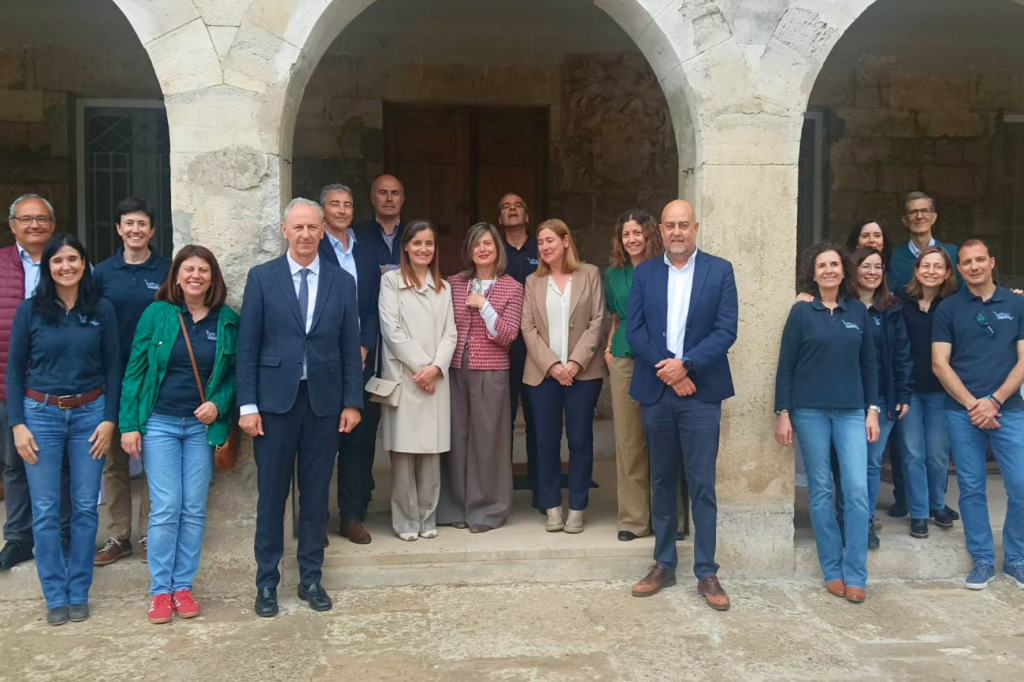
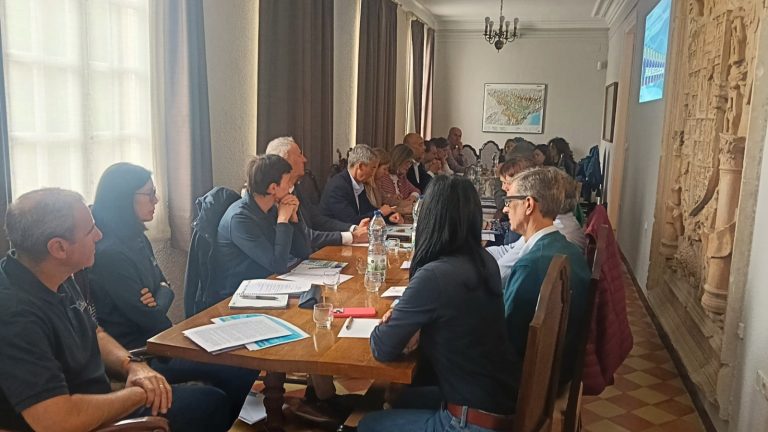
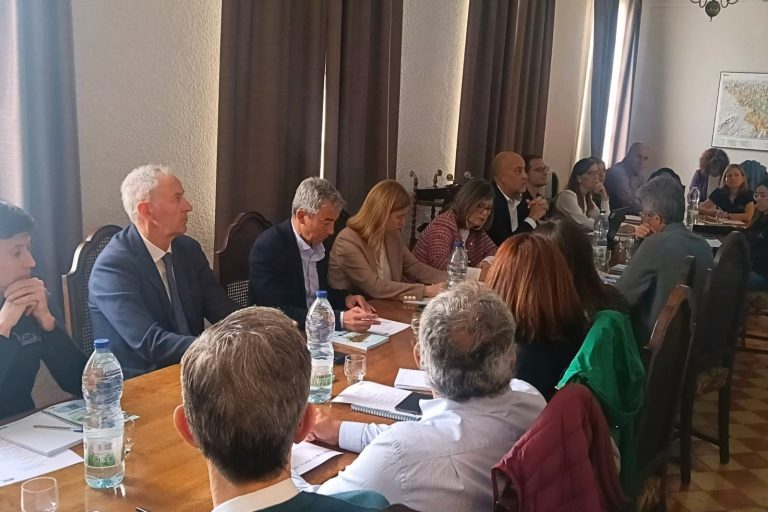
The Committee of Authorities of the Ebro Resilience Strategy met this morning in the historic enclave of El Bocal, in Fontellas, Navarra, to renew the commitment of the institutions to the objectives to reduce the risk of flooding that were agreed at the birth of this Strategy in the middle stretch of the Ebro River. This body is made up of the Ministry for Ecological Transition and the Demographic Challenge (MITECO), the Ebro Hydrographic Confederation (CHE) and the Governments of Navarre, La Rioja and Aragon.
The meeting concluded with the proposal to jointly participate in a new call of the LIFE Program of the European Commission, with the same objective, that the population and economic activities coexist with an Ebro in a good state of conservation without the inevitable floods causing significant damage.
The meeting was attended by institutional representatives of the partners: MITECO’s Director General of Water, Mª Dolores Pascual; the President of the CHE, Carlos Arrazola; the Minister of Agriculture, Livestock, Rural World and Environment of the Government of La Rioja, Noemí Manzano; the Director General of Environment of the Government of Navarra, Ana Bretaña ; the director of the Aragonese Water Institute, Luis Estaún, accompanied by the general director of Natural Environment and Landscape of the Government of La Rioja, José Ignacio Sáenz de Urturi; the general secretary of the Aragonese Water Institute, Pilar Royo and the Water Commissioner of the CHE, Miriam Pardos.
They were joined by the Ebro Resilience technical team, who work in a continuous and coordinated manner.
This new proposal, called LIFE Ebro Resilience 2P, seeks to consolidate the inter-administrative collaboration model that has positioned the Ebro basin as a European benchmark in resilience and adaptation to the phenomenon of floods.
Beginnings
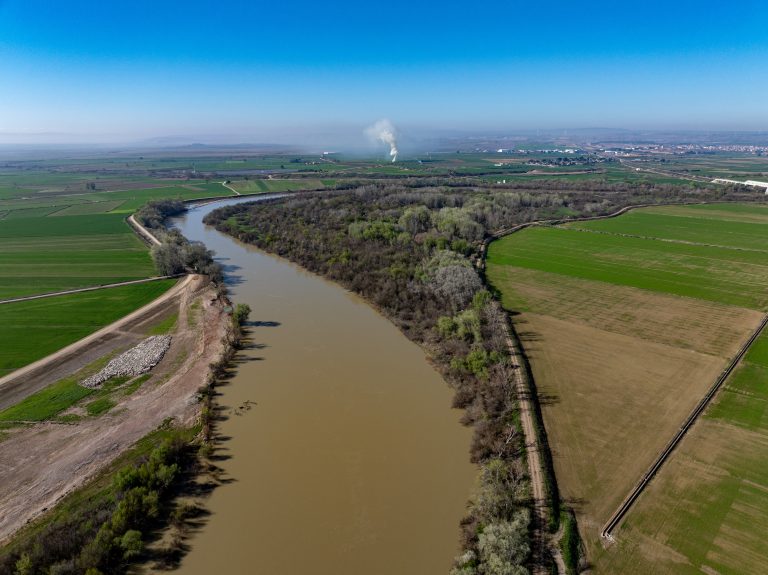
The Ebro Resilience Strategy was born in 2018 in the spirit of all administrations working together as part of the solution following the severe floods suffered in the middle stretch in 2015 and 2018. It was conceived as a collaborative mechanism to implement the measures of the Flood Risk Management Plan (PGRI) in a 325-kilometer stretch between Logroño and La Zaida in a coordinated manner.
In 2020, the current LIFE Ebro Resilience P1 was approved, a project endowed with 13.3 million euros and 55% financing from the European Union, which acts in pilot areas of the three Autonomous Communities to reduce the risk of flooding with Nature-Based Solutions, recovery of river space and innovative proposals to make the socioeconomic activities of the section compatible.
This project has formed a technical team with the project partners, MITECO, through the CHE and the public companies TRAGSA and TRAGSATEC; the governments of La Rioja; Navarra, through Orekan – Environmental Management of Navarra and Aragón, together with the Aragonese Water Institute.
The progress achieved to date demonstrates the effectiveness of the implementation of a coordinated succession of measures after a detailed technical study of the problems of each section and always developing in parallel participatory processes with the population.
In total, 113 hectares of river space have been recovered and 3 km of defenses have been removed or set back.
Actions completed through the LIFE Ebro Resilience P1 Project:
- La Roza (Alfaro, La Rioja): Morphological adaptation and restoration of 22 hectares through the removal of 1,343 m of dikes and the creation of an 800 m relief channel.
- Soto de Alfaro (Alfaro, La Rioja): Reopening of old river branches on 60 hectares, allowing the soto to be flooded with flows of 800 m³/s (previously 1,200 m³/s), improving its irrigation and lamination.
- Mejana del Conde and Meandro de Aguilar (Zaragoza): Retrenchment of longitudinal protections recovering 23 hectares of fluvial space.
- Huerta del Ebro (Fuentes de Ebro, Zaragoza): Burying of 2.3 km of irrigation pipeline to prevent flood damage.
Consolidated actions through the Ebro Resilience Strategy:
- Paraje de La Nava (Alfaro, La Rioja): Retrenchment of 1,376 m of motes and creation of a 40-hectare wetland, a priority habitat for the European mink.
- El Estajao (Alfaro, La Rioja): Excavation of a relief channel and construction of an innovative living wall (Krainer) to protect the water supply on 21 hectares.
- El Ortigoso – Phase 1 (Milagro, Navarra): Removal of 1,790 m of defenses and recovery of two lost branches at the Ebro-Aragón confluence.
- Sections 7 and 9 (Aragón): Works to protect urban centers in Alcalá de Ebro, Remolinos, Torres de Berrellén and Sobradiel from 25-year return floods.
Participation
In addition to a key role of the Local Entities, with the mayors of the localities of the middle stretch at the head, the public participation of the whole society has been at all times a fundamental axis present since the beginning of the Strategy in 2018. Above all, the LIFE Ebro Resilience P1 Project has been a boost to this participation through innovative approaches, which have even been highlighted by the European Commission and more than 3,200 people have been involved in the decision-making processes.
In addition, social capacity building is promoted, opening access to technical knowledge to the entire population to encourage self-protection and co-responsibility. The population becomes an active agent that understands flooding as an inevitable natural phenomenon with which it is necessary to coexist. More than 10,000 people have already gone through the activities proposed through the LIFE Ebro Resilience P1 Project, which has worked in depth with all the sectors involved, highlighting its approach to education in the intervention areas.
Nature-Based Solutions
The project has been recognized as a national success story by being included in the E:SBN catalog (Systematization of Nature-Based Solutions in Spain). Its innovative nature has led the European Commission to highlight its progress and the coordination between partners as a model to be replicated in other rivers in Spain and Europe.