

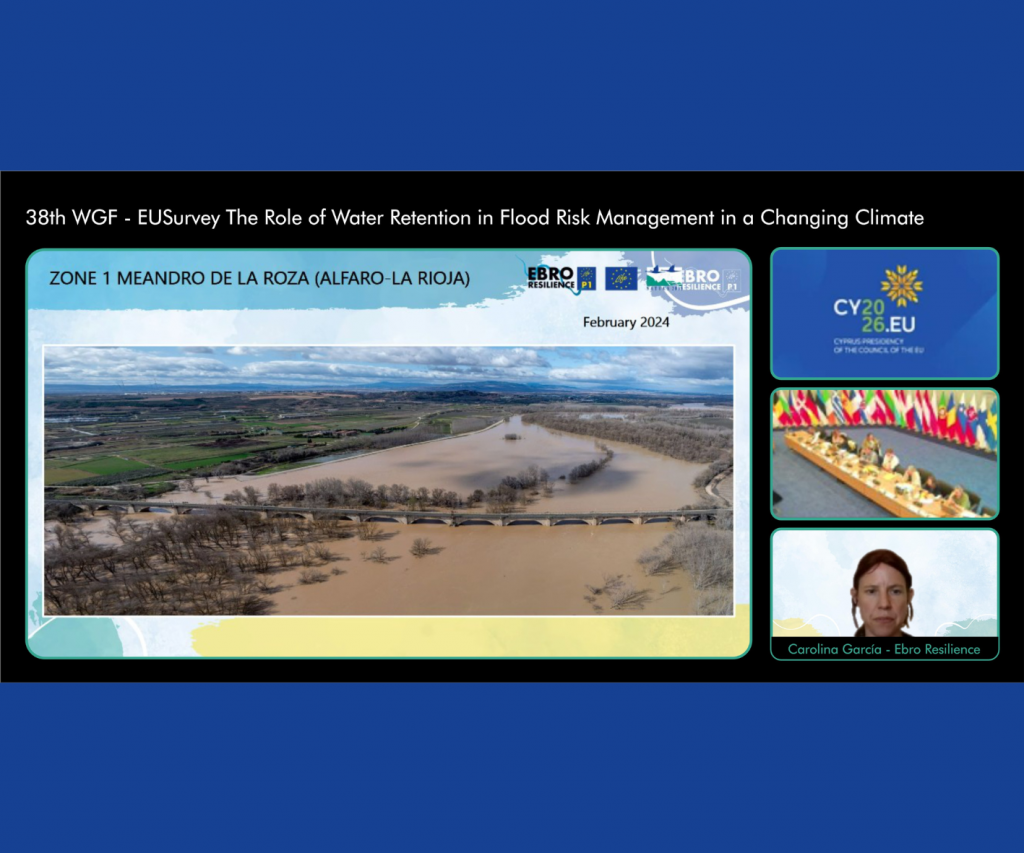
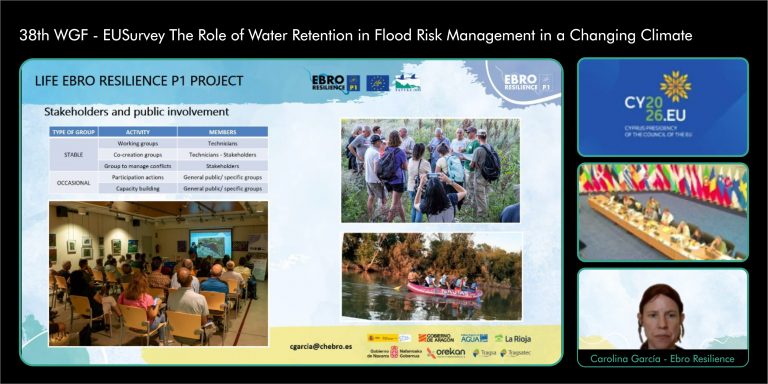
The experience developed in the middle stretch of the Ebro River was the subject of a presentation at the meeting of the EU Working Group on Floods (WGF), the main EU technical and political forum on flood risk management, at the session held on April 7 in Cyprus.
Representatives of the Member States, the European Commission and specialized organizations met there to make progress in the implementation of the Floods Directive and adaptation to climate change.
Within this framework, Carolina García and David Gargantilla, from the Ebro Hydrographic Confederation and technicians of the LIFE Ebro Resilience P1 Project, presented the paper “Floodplain restoration and flood risk management in the Ebro River”.
The intervention has shown how floodplain restoration, improved river connectivity and the integration of nature-based solutions are reducing flood risk, improving the ecological status of the river and increasing resilience to extreme events.
The presentation included a space to discuss the experience of public participation and social capacity building being developed by the LIFE Ebro Resilience P1 Project.
The Ebro is consolidated as a European reference case, both for the magnitude of its actions and for its capacity to combine security, conservation, social participation and climate adaptation.
A top-level European forum
The WGF is the EU’s central coordinating body on floods. Under the Common Implementation Strategy (CIS), this group works on:
The invitation to participate in this forum is a recognition of the work developed in the Ebro and reinforces the European projection of the project.
Exchange, cooperation and international projection
The participation in the WGF adds to the intense networking and technical cooperation work that LIFE Ebro Resilience P1 has been developing in recent years, with initiatives such as:
LIFE Ebro Resilience P1 Project
The LIFE Ebro Resilience P1 Project, which has the financial support of the LIFE Program of the European Commission, is an innovative proposal to address the phenomenon of flooding in the middle stretch of the Ebro, with a clear objective for the future: that the population and economic activities coexist with an Ebro in a good state of conservation without the inevitable floods causing significant damage.
Its partners are the Ministry for Ecological Transition and the Demographic Challenge (MITECO), through the Ebro Hydrographic Confederation (CHE) and the public companies TRAGSA and TRAGSATEC; the governments of La Rioja, Navarra -through Orekan-Gestión Ambiental de Navarra- and Aragón, as well as the Aragonese Water Institute.
.