

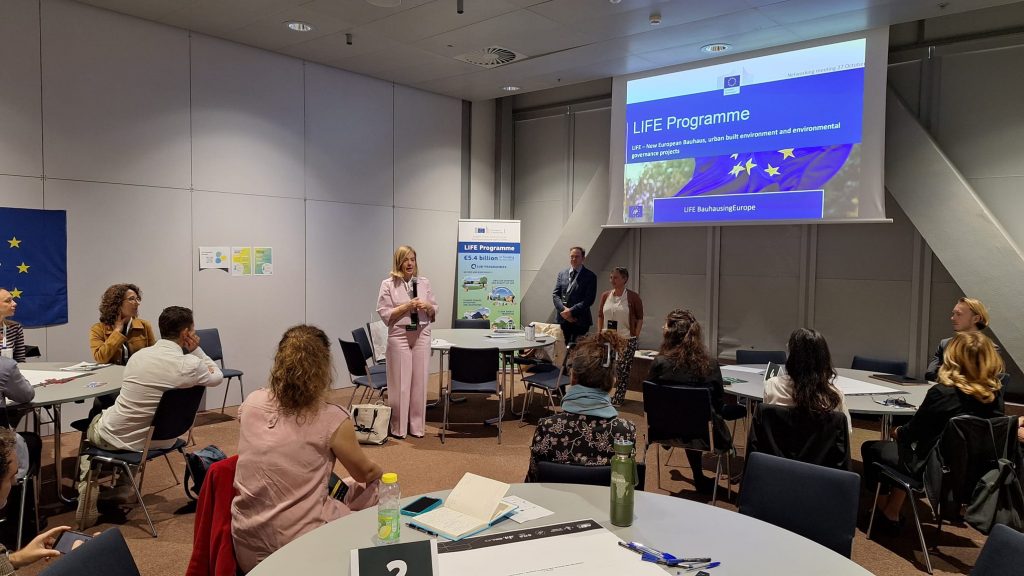
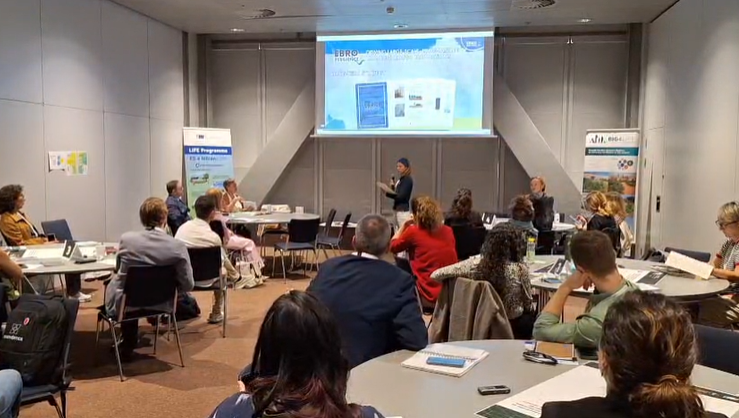
On October 27, the LIFE Ebro Resilience P1 project participated in the 2026 World Congress on Green Infrastructure, held in Barcelona, as part of the workshop “Greening European Cities with LIFE: Inspiring Urban Transformation in Europe.” The session, organized by the European Climate, Infrastructure, and Environment Executive Agency (CINEA) in collaboration with the University of Lleida, brought together ten LIFE projects to share experiences and discuss the social and institutional challenges of transforming regions.
Ebro Resilience’s involvement stems from its expertise in two key areas for these processes: dialogue with local stakeholders and coordination and collaboration among public administrations. Although the project focuses on reducing flood impacts in the middle reaches of the Ebro River—rather than in urban areas—its approach combines nature-based solutions with a territorial perspective in which communication and public participation are integral parts of the work.
The workshop is part of the LIFE Program’s contribution to the New European Bauhaus, a European Union initiative that promotes more sustainable, inclusive, and attractive spaces by combining environmental considerations, design, and citizen participation.
Experiences in Participation and Cooperation
LIFE Ebro Resilience P1 was represented by David Gargantilla, the project’s technical coordinator, and Carolina García, representing the project team. Both are from the Ebro River Basin Authority (CHE), a project partner alongside the Ministry for Ecological Transition and the Demographic Challenge and the public companies TRAGSA and TRAGSATEC; the Government of La Rioja; the Government of Navarre, through OREKAN–Environmental Management of Navarre; the Government of Aragon; and the Aragonese Water Institute.
Flood risk management and the restoration of riverine areas require actions on the ground, but also clear information, dialogue with the public, and collaboration with the affected sectors.
The Ebro Resilience initiative demonstrates the role of communication and participation in these processes—which affect various municipalities, activities, and interests—and the importance of cooperation among government agencies in addressing a shared challenge.
The workshop was divided into two parts. In the first part, the participating projects presented their experiences and their contributions to public policy, collaboration with local and regional authorities, and citizen engagement.
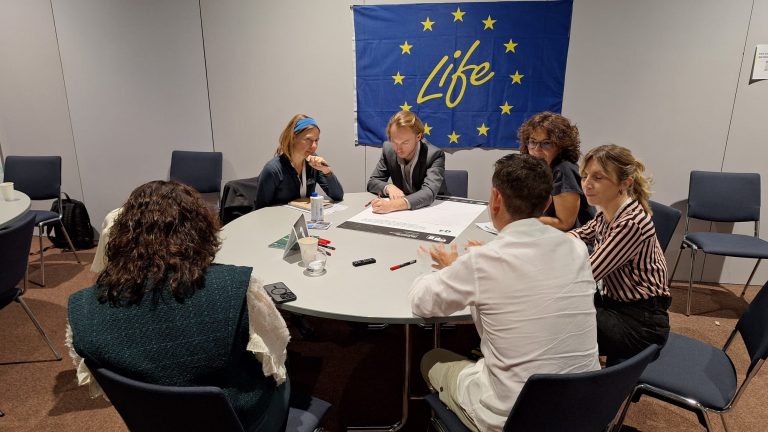
In the second session, a participatory session based on the World Café , brought attendees together at four discussion tables to address the future challenges of urban transformation in Europe. Among the issues raised were scaling up effective solutions, strengthening governance, inclusion, financing, and long-term sustainability.
Visit the CINEA booth
In addition to participating in the workshop, LIFE Ebro Resilience P1 was represented at the CINEA booth, which it shared with the other nine LIFE projects participating in the session.
The event provided an opportunity to showcase the project through a video and informational materials, as well as to exchange experiences and network with professionals and representatives from other European initiatives.
This participation has made it possible to share Ebro Resilience’s experience in communication, public engagement, and cooperation among government agencies—all of which are essential for addressing environmental challenges from a territorial and social perspective—on an international stage.