


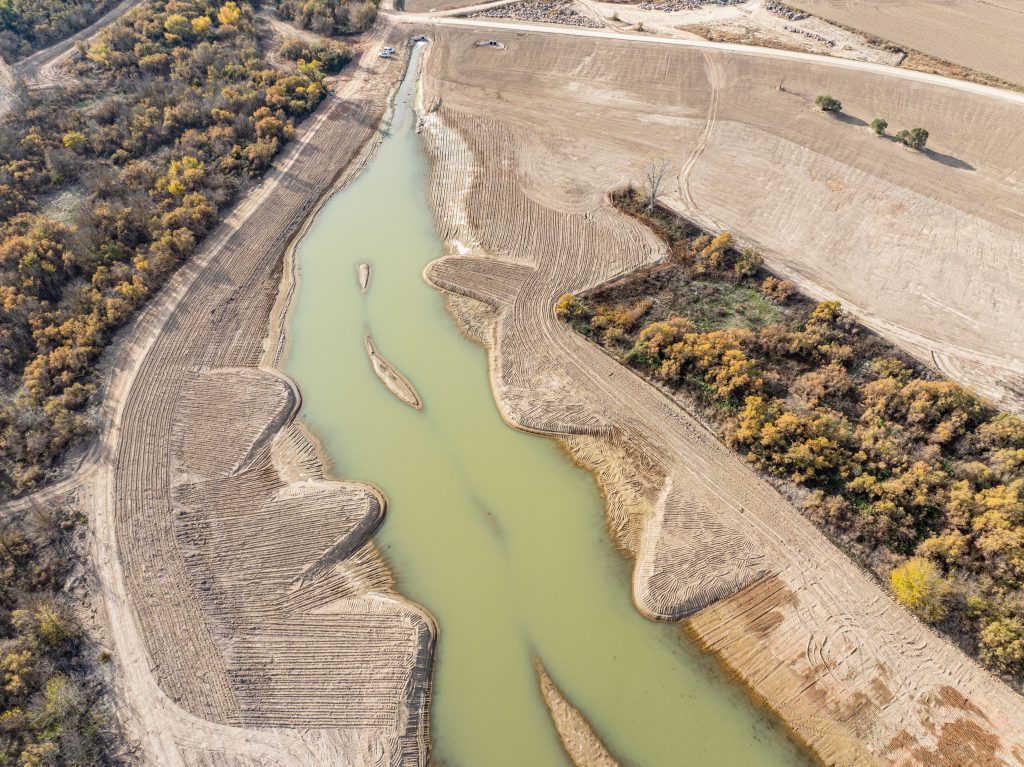
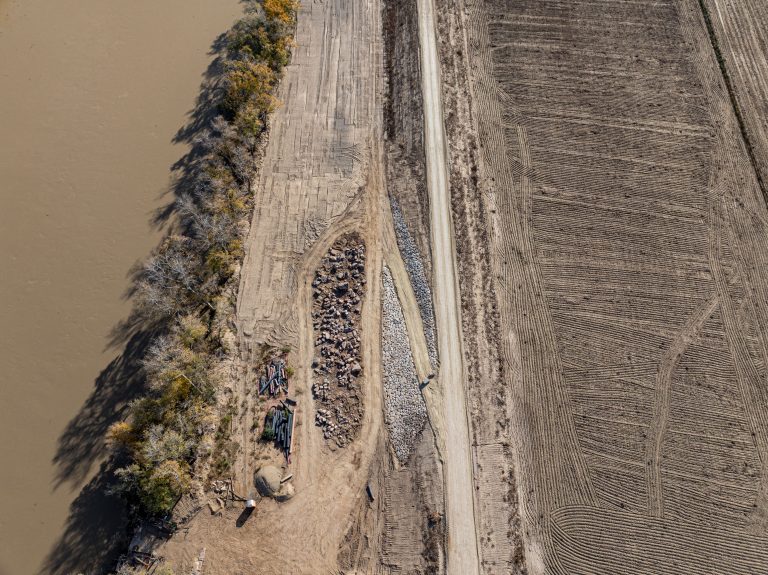
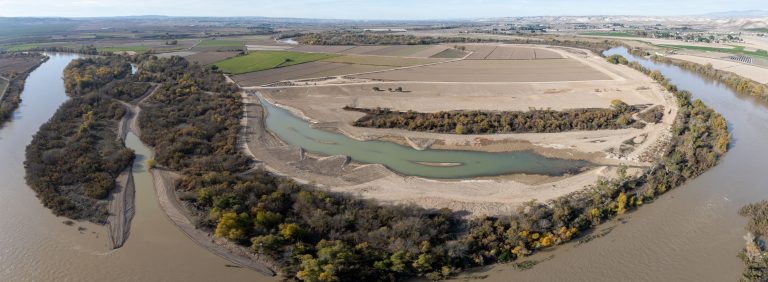
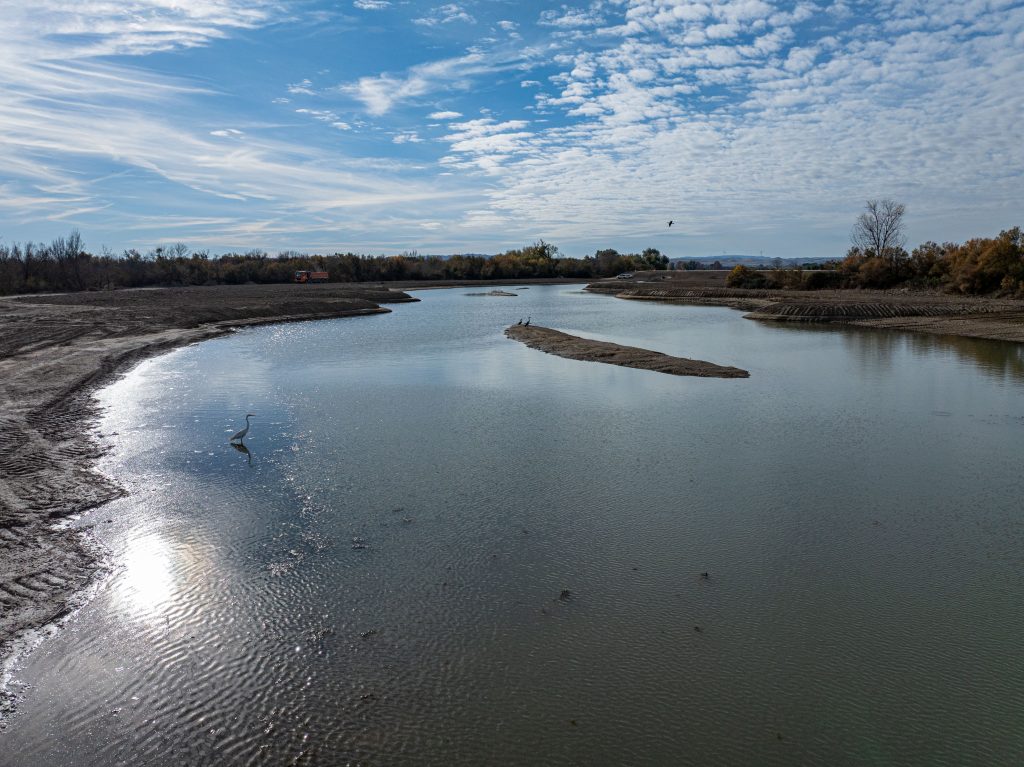
Another step forward in the actions for adaptation to flood risk promoted by the LIFE Ebro Resilience P1 Project. Zone 2, section Osera de Ebro – Fuentes de Ebro (Zaragoza), already has an environmental restoration project to support the renaturalization of the recovered fluvial space after removing the defenses that generated narrowings in the mejana del Conde and the meander of Aguilar.
The Government of Aragon, through the Directorate General of Forest Management of the Department of Environment and Tourism, has defined the environmental restoration project for the recovery of habitats in the 23 hectares that have been added to the river at these two points after the recessing of defenses executed by the Hydrographic Confederation of the Ebro.
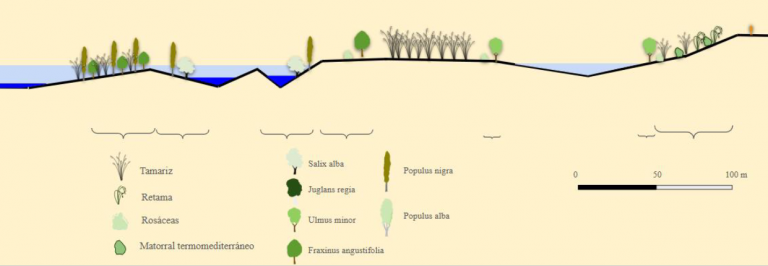
The key action is the planting of 12,500 native specimens in vegetation mosaics, which will favor the regeneration of the undergrowth and the natural expansion of the riparian forest. They will be distributed in different revegetation modules adapted to the conditions of the terrain and the dynamics of the river.
This intervention is in addition to the previous step of the restoration that has been carried out during the regrading works, the new wetland of 1.4 hectares in the Meandro de Aguilar that will contribute to the improvement of biodiversity and the natural capacity of water and sediment storage.
Native species and riparian habitats
Restoration will be based on species characteristic of the riparian forests and thickets of the middle Ebro. The tree species include black poplar(Populus nigra), narrow-leaved ash(Fraxinus angustifolia), white willow(Salix alba), elm(Ulmus minor) and walnut(Juglans regia). In the shrub and bush stratum, tamarisk(Tamarix gallica), hawthorn(Crataegus monogyna), rose bushes and blackberries(Rosa spp. and Rubus ulmifolius), broom (Retama sphaerocarpa) and blackthorn(Rhamnus lycioides), among other species typical of Mediterranean riparian vegetation, will be planted.
Among these plantations, elm trees stand out, since they will be clones resistant to graphiosis (a disease that seriously attacks this species, supplied by the Ministry of Ecological Transition and Demographic Challenge) and poplars(populus), as cuttings from the mother stock field of the Centro de Investigaciones Técnológicas Agrarias del Gobierno de Aragón will be used, with the capacity to produce a variety of clones of native origin from groves and riverbanks very close to the work area, thus guaranteeing the genetic compatibility of the specimens.
These plantations will expand, improve and create new riparian habitats, from willow and poplar groves to tamarisk and shrublands linked to fast-flowing rivers, reinforcing the ecological connectivity of the river corridor and the functionality of the Natura 2000 Network in this section.
Participation and co-creation with the territory
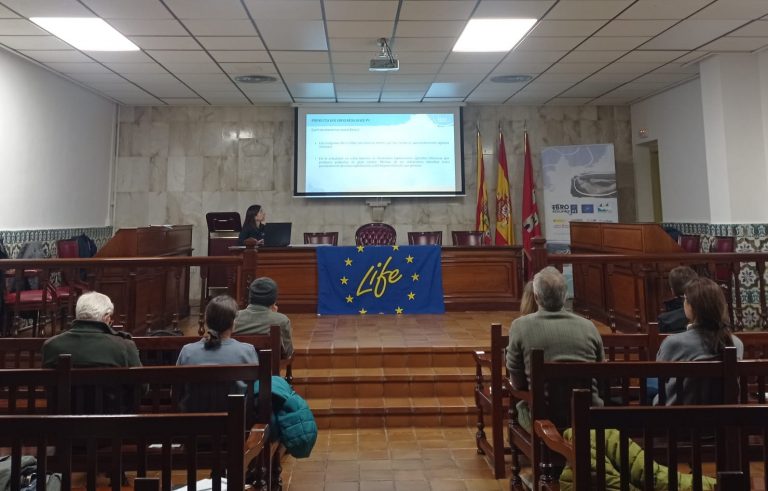
The design of this restoration has been shared in the co-creation groups of LIFE Ebro Resilience P1, working spaces that bring together local people, representatives of the territory and technical staff of the partner entities. In the last meeting of the nature and biodiversity group of the Osera-Fuentes section, held in the town hall of Fuentes de Ebro on December 2, the new steps of the environmental restoration were presented and contributions were collected to continue adjusting the actions to the needs of the environment.
This process of real participation and continuous exchange allows decisions about the river space to be made in a transparent manner, sharing technical information and explaining how restoration measures contribute to both nature conservation and flood protection.
Interventions in progress
In 2025, the Ebro added 23 hectares to its natural flood plain by solving the narrowing of the river at two points, Mejana del Conde and Meandro de Aguilar in the Osera de Ebro – Fuentes de Ebro section (Zaragoza).
The setting back of longitudinal protections (motes), moving them away from the river, has been one of the main actions of Phase 1 of the “Improving resilience to floods in the Ebro” intervention of the LIFE Ebro Resilience P1 Project, with a budget of 3 million euros, which has been implemented by the Ebro Hydrographic Confederation (CHE), through the public company TRAGSA (both partners of the Project).
As in all Ebro Resilience interventions, the participation of the interested sectors, especially in this case that of the farmers, led by the Irrigation Community of the Huerta del Ebro, as well as the consensus with the City Councils of Osera de Ebro and Fuentes de Ebro, have been crucial for the development of the adaptation proposal promoted by the LIFE financial instrument of the European Commission.
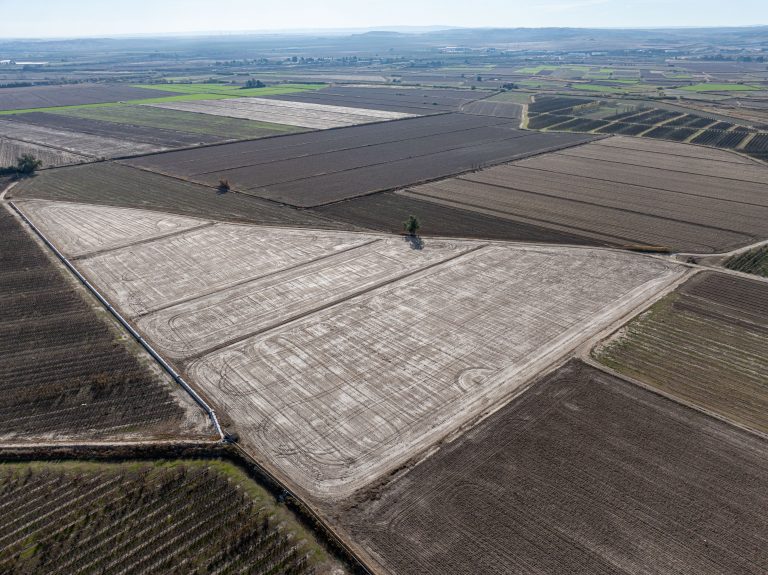
In parallel to this intervention, the execution of PHASE 2 is also progressing, which focuses on one of the reference and pioneering interventions of the LIFE Ebro Resilience P1 Project: the creation of the Lateral Flow Buffer Zones (LFZ) that aim to reduce the risk of flooding in the agricultural area on the right bank of the Ebro in this section.
This involves the creation of a succession of 14 concatenated temporary flood zones that will function as “water cushions” during extraordinary floods.
It applies the concept of adaptation and seeks to give space to the river when it needs it in order to avoid greater impacts. The ZAFLs compartmentalize the arable area, an 11.30 km long area of 630 hectares, into cells that will be pre-flooded in a controlled manner during episodes of Ebro flooding. The water thus passes over water and, as it does not impact on rigid elements and surfaces, damage and erosion are reduced.
– They allow faster recovery after a flood by reducing erosion and allowing water to drain away after the event.
– Lower costs by reducing damage to land and infrastructure during major flood events.
LIFE Project
The LIFE Ebro Resilience P1 Project (LIFE20 ENV/ES/00327), approved by the European Commission in the LIFE 2020 call, covers three autonomous communities (La Rioja, Navarra and Aragón), has a duration of 6 years and a total budget of 13,310,350 €, with 55% European funding.
This project is also an example of institutional coordination and cooperation in the intervention section, being its partners the Ministry for Ecological Transition and Demographic Challenge (MITECO), through its companies TRAGSA and TRAGSATEC; Ebro Hydrographic Confederation; Government of La Rioja; Government of Navarra, through Orekan – Environmental Management of Navarra; Government of Aragon and the Aragonese Water Institute.