


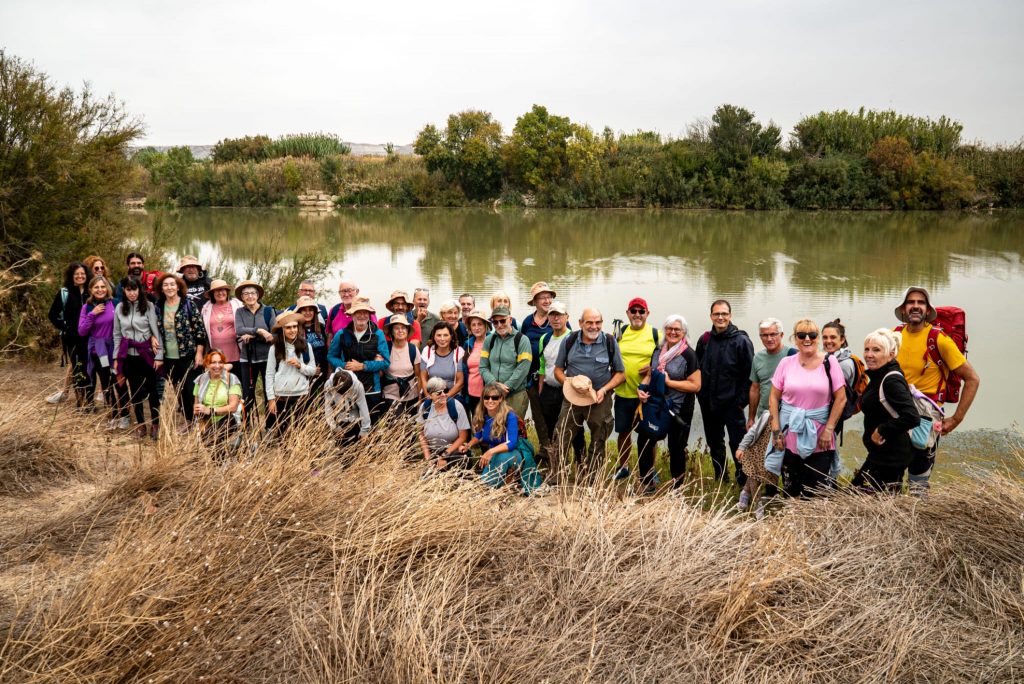
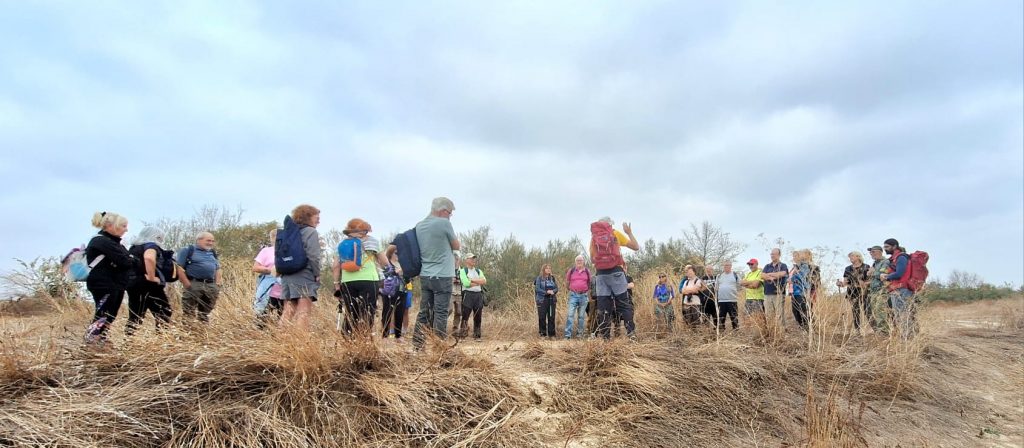
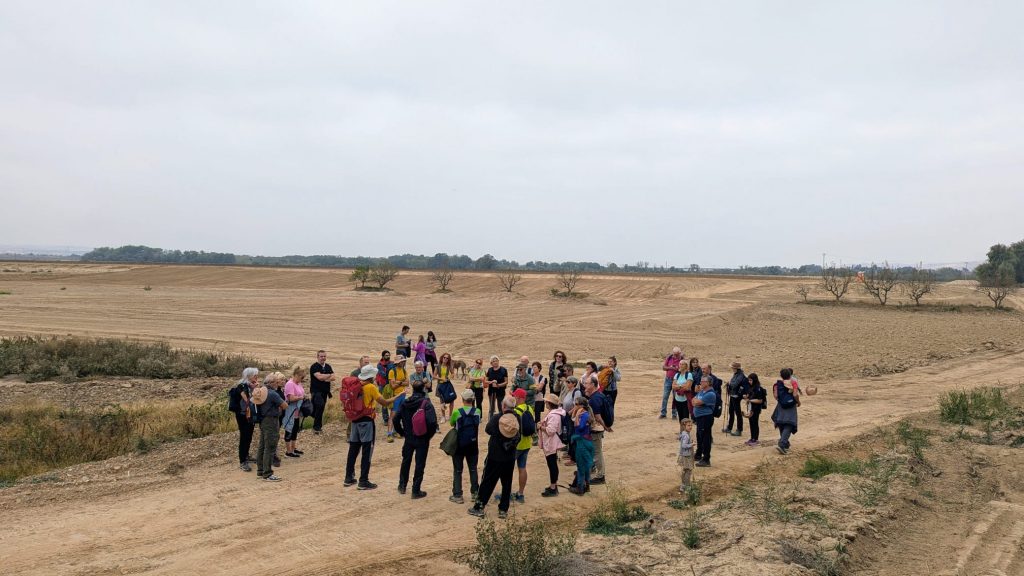
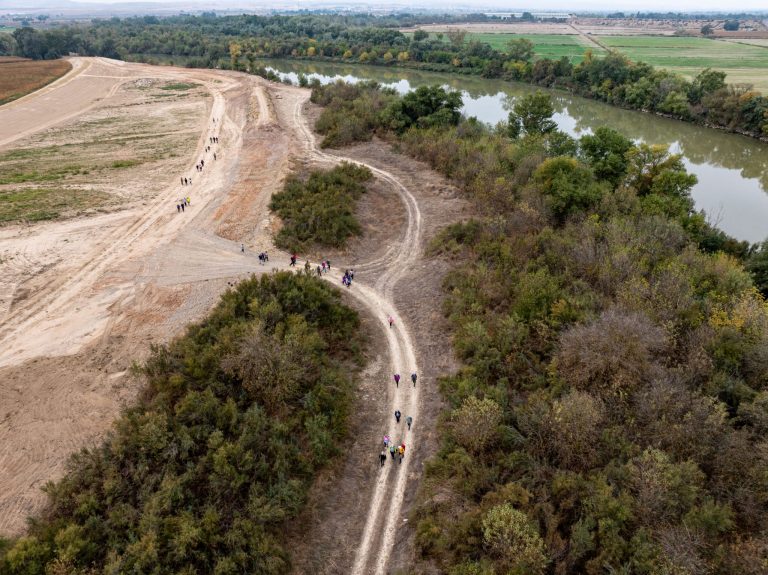
On Saturday, October 18, a group of 45 people enjoyed an interpretative route through the Aguilar meander, in Fuentes de Ebro (Zaragoza), organized by the LIFE Ebro Resilience P1 Project, with the collaboration of the Fuentes de Ebro City Council.
A day of fun and contact with the territory enjoyed by residents of Fuentes de Ebro, Pina de Ebro, El Burgo de Ebro and Zaragoza, among other riverside towns and had two objectives: firstly, to meet around the river, its groves and discuss the population’s perception of the risk of flooding and, secondly, to learn first-hand about the works being carried out, with 55% European funding, in the Osera de Ebro – Fuentes de Ebro section, to reduce the risk of flooding.
The participants were able to approach the work area and ask questions about the actions during a guided tour with technicians of this project, dedicated to reducing the risk of flooding in the middle stretch of the Ebro.
In this meander of Aguilar and in the mejana del Conde, narrowing of the river has been solved, recovering 23 hectares as floodplain and thus gaining fluvial space during river floods. This work has been carried out within the LIFE Ebro Resilience P1 Project by the Ebro Hydrographic Confederation and includes the creation of a new wetland in the meander. In this recovered space, the Government of Aragon will carry out an environmental restoration, reconnecting the space with the riparian groves.
During the visit, another intervention was also explained, one of the most outstanding of the LIFE Project, which is now underway in the section of Osera de Ebro and Fuentes de Ebro. This is a pioneering action for the adaptation to flooding of the agricultural area through the creation of Lateral Flow Buffer Zones (LFZ).
ZAFL
The neighbors who attended the meeting were interested in this proposal, which involves the creation of 14 concatenated temporary flood zones that will function as “water mattresses” during extraordinary floods.
It seeks to give space to the river when it needs it in order to avoid greater impacts. The ZAFLs compartmentalize the cultivable area, an 11.30 km long area of action, into cells that will be pre-flooded in a counter-flooded manner during the Ebro flood episodes. The water thus passes over water and, as it does not impact on rigid elements and surfaces, damage and erosion are reduced.
Public participation
This is the second route that has taken place in the meander, the first was held in the spring of 2024 and both are in addition to other activities that have been held to bring the project and knowledge about flood risk: popular boat descents, actions with teachers, etc.
LIFE Project
The LIFE Ebro Resilience P1 Project (LIFE20 ENV/ES/00327), approved by the European Commission in the LIFE 2020 call, covers three autonomous communities (La Rioja, Navarra and Aragón), has a duration of 6 years and a total budget of 13,310,350 €, with 55% European funding.