


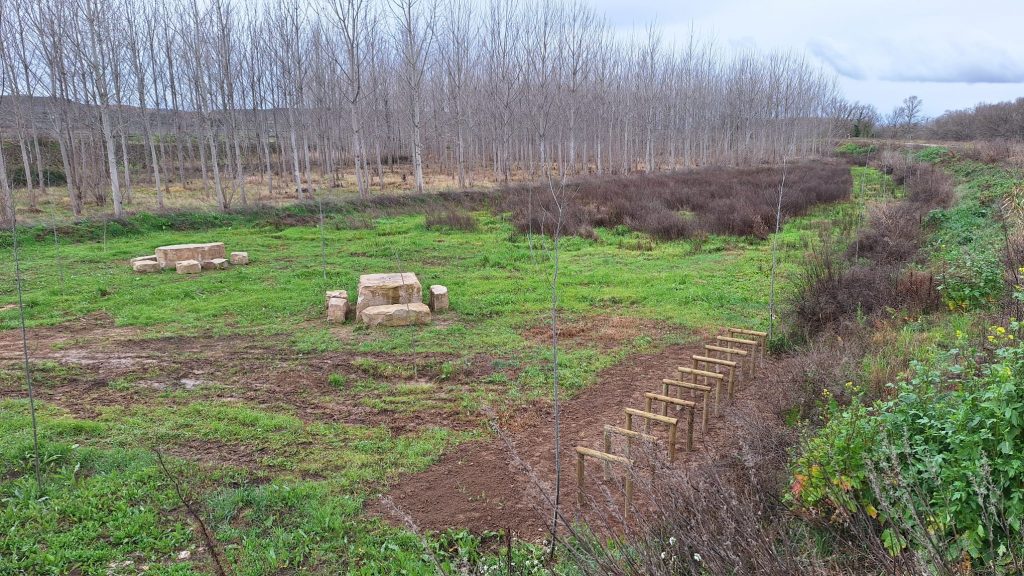
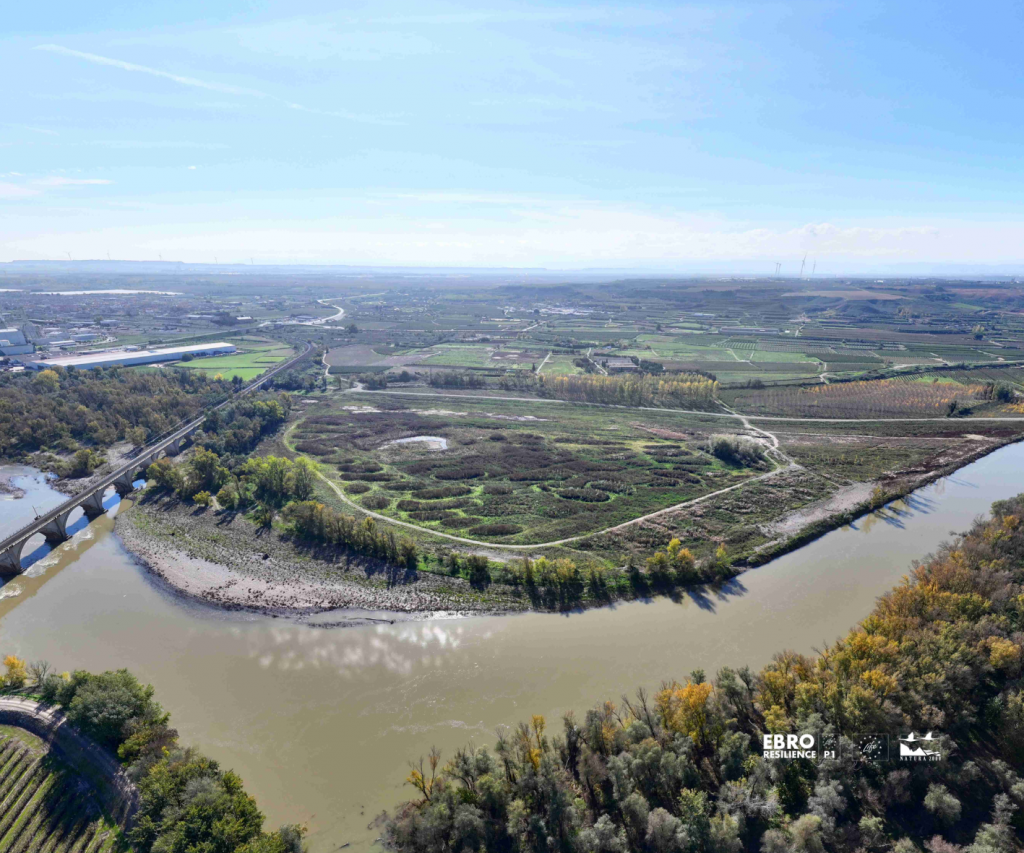
The LIFE Ebro Resilience P1 Project has added a new initiative with the completion of improvement work on the plot—located outside the public water domain—that was made available for public use during the process of setting aside land for the morphological restoration of the La Roza meander, in Alfaro (La Rioja). This space, which has been transformed with the active collaboration of the public, is now ready for people to enjoy.
The uses for this 2,000-square-meter plot were defined through a participatory process that included a deliberative forum open to the entire community, which drew on input from the co-creation groups (which brought together experts and stakeholders throughout the project). The agreed-upon proposals were evaluated and had to be compatible with the management of the Sotos de Alfaro protected area as part of the Natura 2000 Network.
A rest area for cycling tourists has been set up on the property, with aA wooden bicycle rack, with stone furniture (two tables and their respective benches) and a grove of white poplars that will provide shade. Elm trees resistant to Dutch elm disease have also been planted.
The project will soon be completed with the installation of an informational panel on agriculture in the area—covering its history, regions, and crops—as well as other relevant information, which will enhance visitors’ understanding of the area’s history and biodiversity.
Public participation has been fundamental to the success of this project, and the LIFE Ebro Resilience P1 team thanks all those who have contributed their ideas and time. This reclaimed space not only benefits the environment, but also provides a place for the local community and visitors to meet and enjoy.
La Roza
The project is part of the “combined actions phase,” a series of mitigation measures that, taken together, provide an overall benefit and include the planned project at the El Señorío meander in Castejón, Navarre, and the restoration project at Soto de Alfaro.
Specifically, with the morphological adaptation of the meander of La Roza, 22 hectares of river plain have been recovered and integrated as a protected area in the Natura 2000 Network, with the removal of 1,343 meters of defensive dykes that constrained the river and the construction of a smaller defense (899 meters) and away from the riverbed.343 meters of defensive dikes that constricted the river and the construction of a smaller defense (899 meters) and away from the riverbed, returning this space to the river and the planting of more than 4,000 poplars, poplars and ash trees to facilitate the recovery of the riverside forest that some decades ago occupied these lands.
In addition, river dynamics have been improved: